01 · Climate Anomaly
California Seasonal Temperature Dashboard
Seasonal ERA5-Land temperature and anomaly mapping comparing 2024 conditions to a 1991–2020 baseline.
Study Area: California · Dataset: ERA5-Land
Independent Project · Google Earth Engine · 2026
Executive Summary
A structured Google Earth Engine case study built to help planners, analysts, and stakeholders identify where environmental risk and opportunity are concentrated.
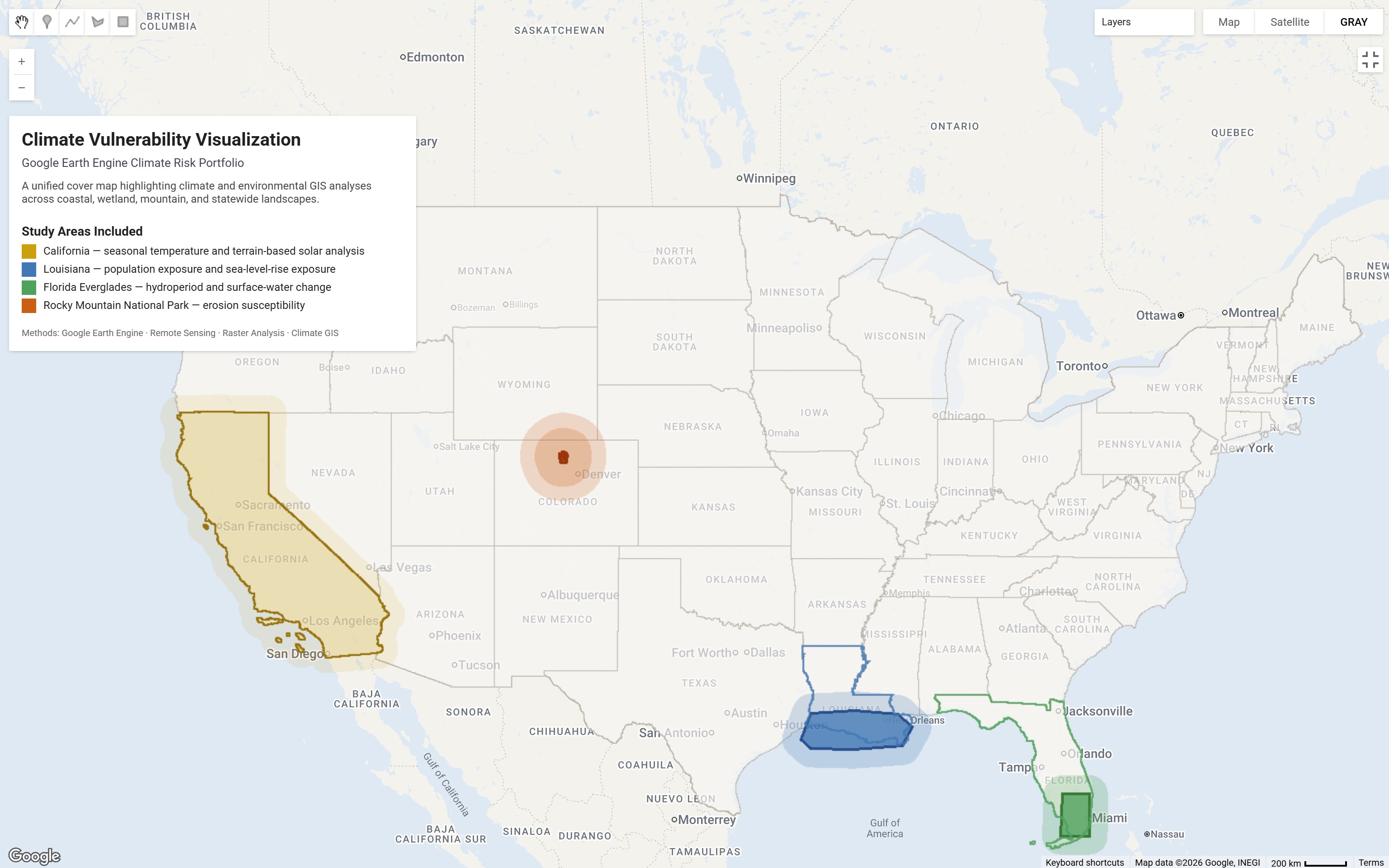
This project series was built to show how satellite data, climate reanalysis, terrain models, population grids, and administrative boundaries can be combined into decision-ready geospatial products. Each dashboard moves beyond a static map: it includes summary metrics, exportable rasters, CSV tables, and a clear visual explanation of where environmental risk or opportunity is concentrated.
The work emphasizes screening-level environmental GIS: fast, reproducible workflows that help planners, analysts, and stakeholders understand where to look first. The results are not replacements for engineering, hydrodynamic, or field-calibrated studies. They are structured geospatial decision-support products designed to communicate patterns clearly and honestly. Methodological scope and limitations are detailed in the Methodology section below.
Designed as a portfolio-grade demonstration of Google Earth Engine, raster analysis, dashboard design, climate adaptation mapping, and remote sensing communication.
Project Outcomes
Six-Part Portfolio Series
Each project includes code, exported rasters, summary tables, screenshots, and methodology documentation.
01 · Climate Anomaly
Seasonal ERA5-Land temperature and anomaly mapping comparing 2024 conditions to a 1991–2020 baseline.
Study Area: California · Dataset: ERA5-Land
02 · Renewable Energy GIS
Slope, aspect, and elevation scoring workflow identifying terrain conditions favorable for solar development.
Study Area: California · Dataset: SRTM DEM
03 · Wetland Monitoring
Long-term surface-water persistence and hydroperiod change analysis using JRC Global Surface Water Yearly History.
Study Area: Florida Everglades · Dataset: JRC Global Surface Water
04 · Climate Vulnerability
Low-elevation population exposure model identifying coastal and delta communities vulnerable to sea-level rise.
Study Area: Louisiana · Dataset: WorldPop
05 · Coastal Hazard GIS
Screening-level inundation mapping for 0.5m, 1.0m, and 2.0m sea-level-rise scenarios across coastal Louisiana.
Study Area: Coastal Louisiana · Dataset: NASADEM
06 · Conservation GIS
Simplified RUSLE-style erosion susceptibility model using rainfall, slope, vegetation, and protected-area boundaries.
Study Area: Rocky Mountain National Park · Dataset: CHIRPS
Workflow
The goal was not only to produce maps, but to build clean, documented, exportable GIS workflows that are transparent, reproducible, and reviewable on GitHub.
01
Each dashboard starts with a decision-oriented question: where is exposure concentrated, where are conditions changing, or where is suitability highest?
02
Public Earth Engine datasets are filtered, clipped, converted, reclassified, or summarized using consistent raster and feature workflows.
03
Each project outputs styled maps, raw or supporting GeoTIFF layers, CSV tables, screenshots, code, README files, and methodology documentation.
Data Sources
Swipe or scroll horizontally to view all columns.
| Dataset | Domain | Applied In |
|---|---|---|
| ERA5-Land | Climate reanalysis | California Seasonal Temperature Dashboard |
| SRTM DEM | Terrain model | California Terrain-Based Solar Suitability |
| JRC Global Surface Water | Surface water history | Everglades Hydroperiod Analysis |
| WorldPop | Population grid | Louisiana Population Exposure |
| NASADEM | Elevation model | Louisiana Sea Level Rise Exposure |
| CHIRPS | Precipitation | Rocky Mountain Soil Erosion Risk |
Methodological Scope & Limitations
These dashboards are screening-level products, built to identify where environmental risk or opportunity is concentrated and to communicate spatial patterns clearly. They rely on publicly available climate, terrain, hydrology, and population datasets at native resolutions ranging from 30m to 9km, processed using standard, documented raster and vector workflows within Google Earth Engine.
They are not a substitute for engineering-grade, hydrodynamic, or field-calibrated analysis. No field validation, ground-truthing, or independent accuracy assessment has been performed against these outputs. Results should be treated as a starting point for further investigation, not as a final basis for engineering design, permitting, or regulatory decisions.
Deliverables
The project is organized so a reviewer can quickly understand the analysis, inspect the code, view the screenshots, and download the outputs.